
Why Strength Training Matters After 60
Adults can lose up to 8% of muscle mass per decade between ages 65 and 80, and that loss is the single biggest predictor of falls, fractures, and loss of independence in seniors (Harvard Health Publishing, 2024). The good news: muscle is one of the only organs you can rebuild at almost any age. Done safely, strength training is the most powerful tool a senior over 60 has to stay walking, standing, and living on their own terms.
What Families Need to Know in 90 Seconds
- Muscle loss after 60 is reversible. Even nonagenarians have gained 174% strength after 8 weeks of high-intensity strength training (Fiatarone et al., JAMA, foundational study cited in 2024 reviews).
- The sarcopenia problem is bigger in India. 43.6% of community-dwelling Indian adults aged 60 and above show sarcopenia, with 19.4% in the severe range (LASI analysis, Journal of the American Geriatrics Society, 2025).
- Two sessions a week is the floor. The WHO 2020 guidelines for adults 65 and over recommend muscle-strengthening on at least 2 days a week plus balance work on 3 days a week (WHO & British Journal of Sports Medicine, 2020).
- Resistance training cuts mortality. Older adults who lift weights regularly have a 15% lower all-cause mortality and a 19% lower cardiovascular mortality (American Journal of Preventive Medicine, 2022).
- It also improves blood sugar. Resistance training drops HbA1c by about 0.50 percentage points in adults with Type 2 diabetes -- comparable to adding a second medication (Wan & Su, Sage, 2024).
- Safety beats intensity. The right form, the right load, and the right supervision matter more than how much weight is on the bar.
How Much Muscle Do Seniors Actually Lose?
Sarcopenia, the medical term for age-related muscle loss, hits 5-13% of adults aged 60-70 globally and 11-50% of adults aged 80 and above (von Haehling et al., NIH/PMC sarcopenia review, updated 2024). In India the numbers are starker: a 2025 analysis of the Longitudinal Aging Study in India put sarcopenia prevalence in community-dwelling adults 60 and above at 43.6%, with severe sarcopenia at 19.4% (JAGS, 2025). A separate 2025 Indian Consensus on Sarcopenia found primary sarcopenia in 14.2-39.2% of otherwise healthy older Indians (International Journal of General Medicine, 2025).
Why is the Indian number so high?
Three reasons stack up. First, traditional Indian diets, especially vegetarian ones, often fall short on protein for seniors. Second, urban lifestyles after retirement become very sedentary very quickly. Third, decades of high diabetes prevalence accelerate muscle loss. The Indian Consensus on Sarcopenia notes that sarcopenia in Indians shows up earlier and progresses faster than in Western populations (2025).
What does losing muscle actually feel like?
It rarely shows up as obvious weakness at first. Parents say things like "I do not need that jar opened, leave it." They start avoiding stairs. Getting up from a low sofa takes a small "oof." Walking groceries from the car becomes a planned event. By the time the change is visible in the mirror, function has often dropped 20-30%. Catching it early is everything.
What Are the Real Benefits of Strength Training After 60?
In 2024, an Oxford-published meta-analysis showed that older adults doing about 60 minutes of resistance training per week had a 33% lower all-cause mortality, with a clear U-shaped curve where benefits taper above ~130 minutes per week (International Journal of Epidemiology, 2024). For seniors over 60, the message is simple: a little, done well and consistently, beats a lot done occasionally.
Beyond mortality, the documented benefits for adults 60 and above include:
- Mortality: 15% lower all-cause death, 19% lower cardiovascular death, 14% lower cancer death (AJPM, 2022).
- Bone density: High-intensity resistance training (≥70% 1RM) three times a week improves bone mineral density at the lumbar spine, femoral neck, and total hip in postmenopausal women (PMC meta-analysis, 2025).
- Blood sugar: HbA1c drops by ~0.50 percentage points with structured resistance training in Type 2 diabetes; HOMA-IR also improves by 1.15 (Diabetes Research & Clinical Practice, 2025).
- Falls and fractures: Programs of at least 2 sessions a week for 12 weeks or longer produce the largest gains in lower-extremity strength and the biggest fall-risk reductions (European Review of Aging and Physical Activity, 2025).
- Cognition and mood: Resistance training is consistently linked to lower symptoms of depression and improved executive function in seniors.
Is it really safe at 70 or 80?
Yes, when programmed correctly. The landmark Fiatarone study trained frail nursing-home residents with a mean age of 90 at high intensity for 8 weeks. Results: 174% strength gain and 9% increase in mid-thigh muscle area, with no serious adverse events (JAMA). What makes training "safe" is not avoiding load -- it is the right starting load, the right movement pattern, and supervision in the first 6-12 weeks.
Which Strength Exercises Are Safest for Seniors Over 60?
According to the WHO 2020 guidelines for adults 65 and over, the foundation is muscle-strengthening on at least 2 days a week plus multi-component balance activity on at least 3 days a week (British Journal of Sports Medicine, 2020). The exercises below cover the major movement patterns seniors actually need: standing up, sitting down, picking things up, reaching, and walking with confidence.
1. Sit-to-Stand (Chair Squat)
Trains: Quadriceps, glutes, core. Why it matters: The single best predictor of independence after 70 is the ability to stand from a chair without using your hands.
How: Sit on a sturdy chair, feet flat, hip-width apart. Cross arms over chest. Stand up fully without using your hands. Sit back down with control over 3 seconds. Aim for 3 sets of 8-12.
Safety: Place the chair against a wall. If you cannot stand without hands, start by using armrests, then progress to one hand, then no hands.
2. Wall Push-Up
Trains: Chest, shoulders, triceps, postural muscles. Why it matters: Upper-body pushing strength is what helps a senior catch themselves on a counter or wall during a stumble.
How: Stand arm's length from a wall, hands at shoulder height and width. Bend elbows and bring chest toward the wall, keeping body straight. Push back. 3 sets of 10-15. Progress to a kitchen counter, then a sturdy table.
Safety: Keep wrists in line with shoulders. Do not let the lower back sag.
3. Resistance Band Row
Trains: Mid-back, rear shoulders, biceps. Why it matters: Most seniors are stooped from years of sitting and phone use. Rows reverse that posture.
How: Loop a light band around a sturdy post at chest height. Hold one end in each hand, arms extended. Pull the band toward your ribs, squeezing shoulder blades. Slowly release. 3 sets of 10-12.
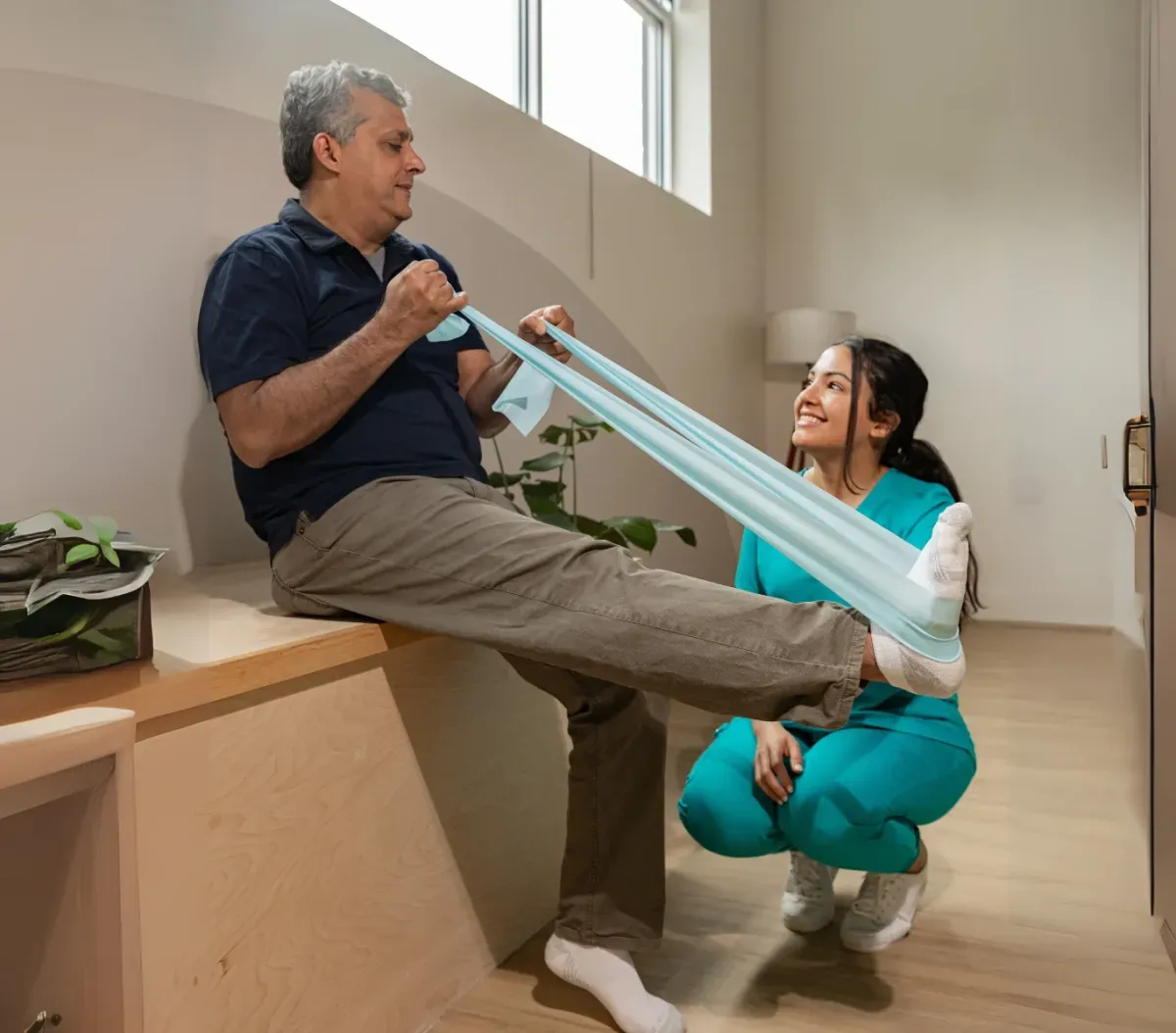
Safety: Pick the lightest band that lets you complete 10 clean reps. Bands are generally safer than free weights for the rotator cuff in this age group.
4. Heel Raises (Calf Raise)
Trains: Calves, ankle stability. Why it matters: Strong calves are critical for balance and prevent the "shuffling gait" that leads to trips.
How: Stand behind a chair, hands lightly on it for balance. Rise onto the balls of your feet. Lower with control. 3 sets of 12-15.
Safety: Lower slowly -- this is where most of the strength gain happens. Stop if any sharp ankle or Achilles pain appears.
5. Single-Leg Stand (Loaded Balance)
Trains: Hip stabilizers, ankle, core, balance. Why it matters: Balance is half of fall prevention. Walking is essentially controlled single-leg standing.
How: Stand near a counter. Lift one foot 5-10 cm off the floor. Hold for 10 seconds. Switch sides. Build to 30 seconds per leg, then progress to holding a light dumbbell in the opposite hand.
Safety: Always have a counter or wall within arm's reach for the first 4-6 weeks.
6. Glute Bridge
Trains: Glutes, hamstrings, lower back. Why it matters: Weak glutes are a major driver of lower back pain and poor walking mechanics in seniors.
How: Lie on your back, knees bent, feet flat on the floor. Lift your hips toward the ceiling, squeezing the glutes. Hold 2 seconds, lower. 3 sets of 10-12.
Safety: Do not let the lower back arch excessively at the top.
7. Suitcase Carry
Trains: Grip strength, obliques, full-body posture. Why it matters: Grip strength is one of the strongest predictors of overall mortality after 60.
How: Hold a 1-3 kg dumbbell or full water bottle in one hand. Walk 15-20 metres standing tall, switch hands, walk back. 3-4 rounds.
Safety: Keep shoulders level. If one shoulder hikes up, the weight is too heavy.
How Should Seniors Structure a Weekly Program?
Programs of at least 2 sessions per week, at least 45 minutes per session, sustained for 12 weeks or more produce the biggest gains in lower-extremity strength and the biggest reductions in fall risk (European Review of Aging and Physical Activity, 2025). For most seniors over 60, the right structure looks like this:
- Day 1 (Strength A): Sit-to-stand, wall push-up, resistance band row, heel raises. 30-40 minutes including warm-up and cool-down.
- Day 2 (Balance & Mobility): Single-leg stands, slow walking practice, gentle yoga or stretching. 30 minutes.
- Day 3 (Strength B): Glute bridge, suitcase carry, wall push-up, sit-to-stand. 30-40 minutes.
- Day 4 (Balance & Mobility): Repeat of Day 2 with progression.
- Day 5 (Strength A or light walking): Optional third strength session for those tolerating the first two well.
- Day 6-7: Walking, household activity, or full rest. Recovery is where adaptation happens.
How heavy is "heavy enough"?
Use the "talking test" applied to lifting: the last 2 reps of every set should feel hard but you should still be able to complete them with good form. If a set feels easy, the load is too light. If form breaks down before the target rep count, the load is too heavy. For older adults this typically means 60-80% of 1RM in the gym, or a band/dumbbell weight you can lift 8-12 times.
How long until results show?
Expect three milestones: weeks 2-4, daily activities feel easier (groceries, stairs); weeks 6-8, measurable strength gain (more reps, heavier weight); weeks 12-16, visible muscle change and lab markers like HbA1c and resting blood pressure begin to shift. The Fiatarone trial saw dramatic gains at 8 weeks, but the bigger changes in body composition and metabolic health appear at 3-6 months.
What Should Seniors Avoid in the First 12 Weeks?
The injuries we see most often in new senior lifters come from a small list of avoidable mistakes:
- Heavy overhead pressing without a shoulder assessment. Frozen shoulder and rotator cuff issues are common after 60; load to tolerance, not to ego.
- Deep squats or deadlifts without coaching. The patterns are fine; loading them without supervision is not.
- Plyometrics or jump training. Never necessary, often dangerous in seniors with osteoporosis or joint replacement.
- Working through sharp joint pain. Muscle soreness for 24-48 hours is normal. Sharp pain in a joint is not.
- Skipping the warm-up. 5-10 minutes of light movement (walking, arm circles, hip openers) cuts injury risk noticeably.
Anyone with controlled hypertension, Type 2 diabetes, mild heart disease, osteoporosis, or osteoarthritis can usually train safely with the right modifications. Active uncontrolled chest pain, recent fracture, or unexplained shortness of breath always warrants a doctor's clearance first.
What About Protein and Recovery?
Strength training without adequate protein is like construction without bricks. Most Indian seniors eat well below the protein levels needed to rebuild muscle. Aim for 1.0-1.2 grams of protein per kg of body weight per day, spread across meals. For a 65 kg senior, that is roughly 65-80 grams a day -- the equivalent of 2 cups of dal, 2 servings of curd or paneer, 1-2 eggs (if non-vegetarian), and a handful of nuts. Vegetarian seniors often need a structured plan to hit this without overloading on carbs.
Sleep is the second pillar. Most muscle repair happens during deep sleep. Seniors who lift in the evening but sleep poorly often plateau in 6-8 weeks. A consistent bedtime, limited evening fluids, and a cool bedroom matter as much as the workout itself.
Your First-Week Action Plan
You do not need to overhaul everything. Pick three things and do them well:
- Day 1-2: Get a baseline. Time how long it takes to do 5 sit-to-stands, hold a single-leg stand for 30 seconds, and walk 10 metres at a normal pace. Write it down.
- Day 3-5: Do the 4-exercise Day 1 routine above (sit-to-stand, wall push-up, band row, heel raises). Twice this week.
- Day 6-7: Walk for 20-30 minutes. Eat one extra protein-rich snack (curd, eggs, paneer, nuts).
Then book a professional assessment. Sarcopenia, balance, joint history, and current medications all change what "safe" looks like for an individual senior. A good geriatric physiotherapist or strength coach should be able to assess and prescribe in a single visit.
If you are in Bangalore and want a doctor-led strength training program built specifically for parents over 60 -- with home assessment, progressive sessions, and nutrition support under one roof -- Kinetic Age offers a free first consultation. Book a Free Trial to find out exactly where to start, safely.